Wednesday, September 28, 2005

"Arbit" World

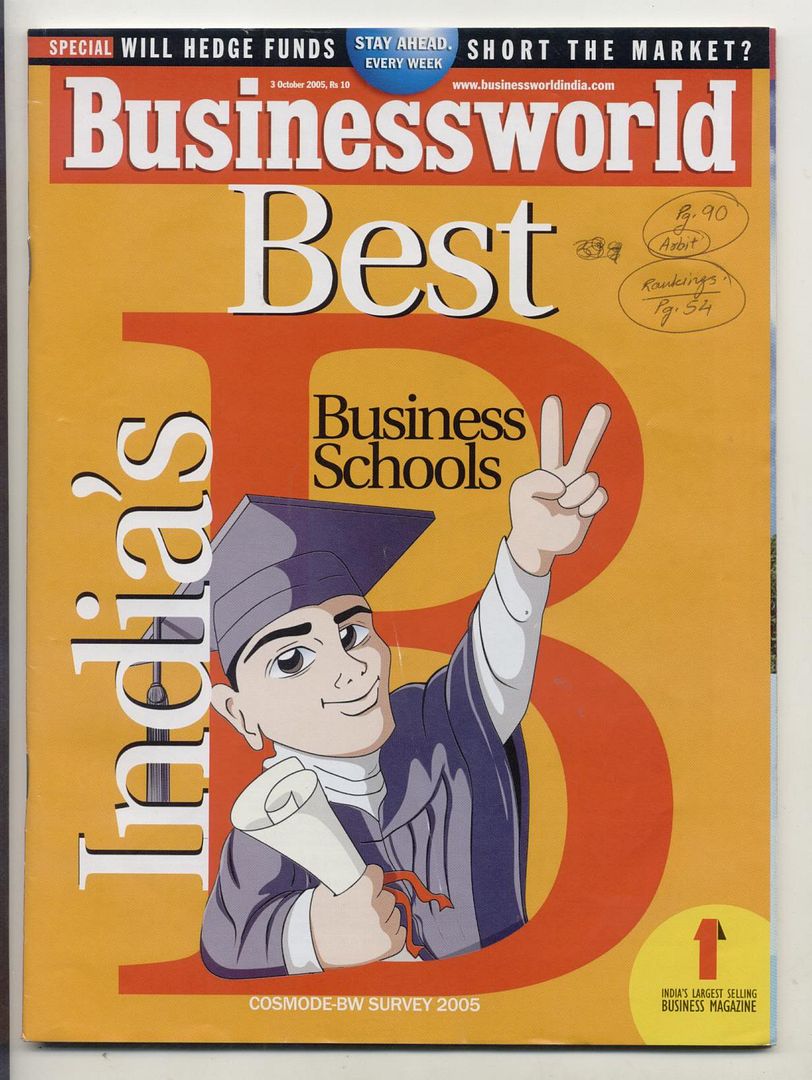
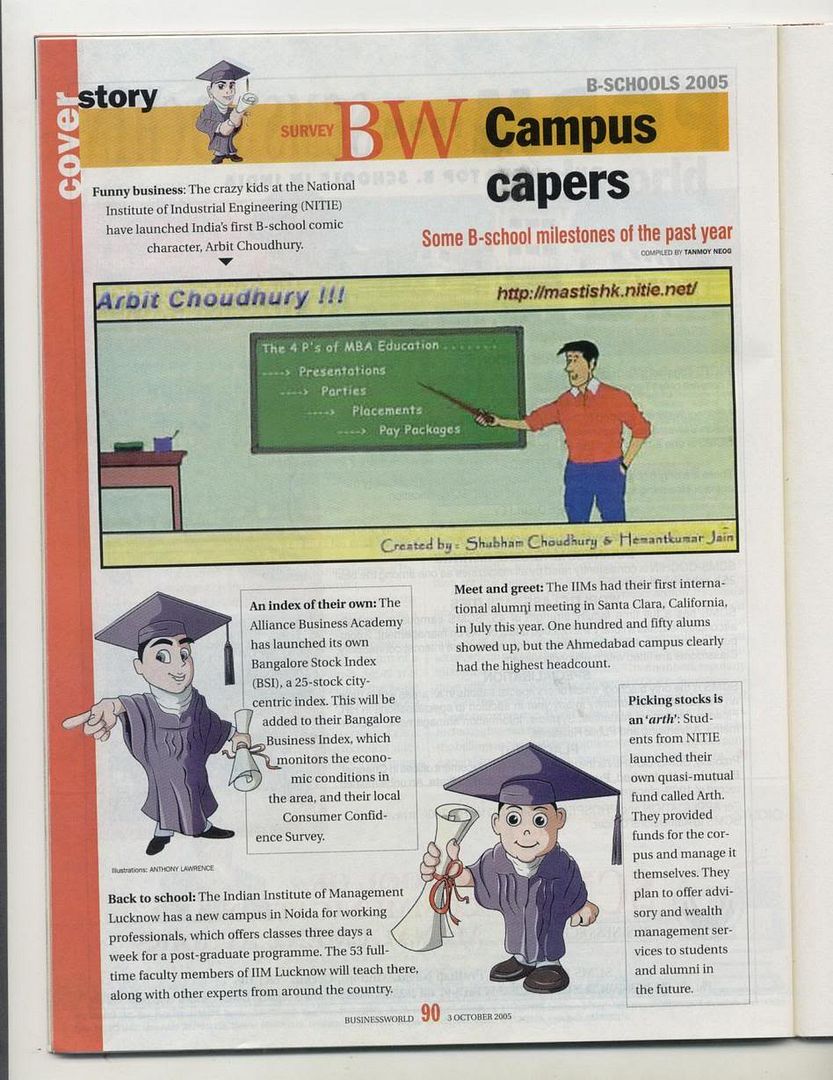
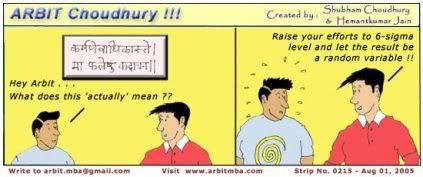
September 2005 has been a month of Arbit milestones. To start things off, on the 5th of this month, Arbit Choudhury- World’s 1st MBA cartoon character celebrated his 1st birthday. Then Arbit transcended from the web world to the SMS domain, with the launch of Arbit SMS Jokes. Arbit Choudhury also appeared in Business World magazine, dated 3rd October 2005 (the online version of the same can be visited at www.businessworldindia.com )
Image hosted by Photobucket.com
And to round things off, I just noticed, the Arbit Choudhury yahoo group, through which the latest editions of Arbit Choudhury comic strips are released twice a month, has become the 10th largest comic strip yahoo group, with 895 members (and counting). This is quite an achievement for a 10 month old group.

On this happy occasion, I would like to thank all Arbit Choudhury fans for their continuous love and appreciation. The truckloads of e-mails which have kept flooding our mailboxes over the last year, have given me and Hemant the inspiration to continue creating Arbit.
Thank you all!!!!

On Arbit Choudhury’s 1st birthday, I hereby release the Character sketches of all other characters in the Arbit world.
Lots more Arbit stuff, including latest Arbit wallpapers and Avatars, can be downloaded from Arbit’s own website- www.arbitmba.com

Image hosted by Photobucket.comImage hosted by Photobucket.comImage hosted by Photobucket.comImage hosted by Photobucket.com

Techie Bill- The Geek
He is one of Arbit’s closest friends. Bill and Arbit used to be roomies in engineering college. Bill had the most brilliant techie brain in campus. No one could match his programming skills, or his knowledge about IT. But somehow, his knowledge never converted into grades. But he was selected by the first IT company to visit campus. And has changed 3 jobs in the last one and half years.
As luck would have it, Bill and Arbit are in the same city now too. They often meet and discuss their apparently divergent worlds. While Bill talks about implementation, delivery and deadlines, Arbit is all strategy, vision, mission. And at the end of the day, both go back thinking that the grass is greener on the other side.

Antique Jain- The Topper
He is the undisputed topper in the batch. He has all it takes to be a topper. Intelligence, discipline, hard work, good PR with profs., he has it all. He is the kind of guy who could rattle off entire chapters of Kotler, have the quarterly profits of all fortune 500 companies at the tip of his tongue, and recognize faces of all CEO’s worth their salt. His dream company- McKinsey. Although there is not much common between Antique and Arbit, they are good friends. While Antique believes in burning the midnight oil, Arbit believes in taking the easy way out, while Antique bases his results on painstaking analysis, Arbit just cooks up data to fit the results he wants. But as they say, opposites attract. Antique often approaches Arbit to get his nagging queries answered, and is more often then not bewildered at the sheer nonchalance with which Arbit cooks up the most outrageous of answers.

Maya- The Girlfriend
Maya and Arbit were batchmates in engineering college. Although Arbit was deeply attracted towards her from day 1, he could never muster enough courage to say those 3 big words to her. As the days and months passed, Maya began to understand Arbit better, and one day proposed to him herself. And they have been together ever since.
Maya is a simple girl, who likes simplicity in every aspect of life. She is often as a loss to understand all the management jargon spewed by Arbit every now and then. She sometimes feels, MBA has made Arbit go further away from reality, into a world where vision, mission are more important than implementation, where plans are more important than execution, where jargon is more important than action. She tries her best to keep Arbit’s feet on the ground, and is the stabilizing force in his life.

Prof. Lingampally Rangareddy- The Task Master
He is the toughest Prof. in campus. A strict no nonsense guy. He specializes in all quantitative analysis tools ever invented. Factor analysis, cluster analysis, QFD, AHP, Test of Hypothesis, 6-Sigma, there is nothing he is not an expert at. Even worse, he expects everyone to use these tools to solve every management problem. As a typical wisecrack doing the rounds in campus goes- Before his marriage, he carefully analyzed the compatibility between him and his prospective wife, not through horoscope, but through QFD!!!
As expected, Arbit is not his favourite student. Arbit stands for everything Prof. Rangareddy dislikes. “All fart, No Gyan”- is Arbit’s way, which is diametrically opposite to the Prof.’s ideology of “All analysis, no fart”. Their exchanges in class are stuff folk laws are made of.....

Now for some funny business.. Out of the hundreds and hundreds of Arbit fan mails we have received, only a handful of people have actually got the spelling of “Choudhury” right.. After reading all those mails, I have realized the many different combinations by which one can write the surname Choudhury.
Here is a list of ways in which people have spelt it.
Arbit Choudhary
Arbit Chaudhary
Arbit Chowdhary
Arbit Chowdhury
Arbit Choudhry
Arbit Chaudhry
Arbit Choudhuri
Arbit Choudhari
Arbit Choudhri
Arbit Chaudhri
Arbit Chowdhuri
Arbit Chowdhari
Arbit Chowdhri
Arbit Chawdhri
Arbit Chowdry

Phew!! I had read that Shakespeare could write a dozen different spelling of his name.. I guess the same applies to Arbit too.. :)
"Creativity is allowing oneself to make mistakes. Art is knowing which ones to keep." - Scott Adams

The End of the Beginning

It’s over.. finally and officially.. I have finished something I have been pursuing for the last 20 years.. Yes, my student life has ended.. With the results of the final project in my B-school out, (in which an AB grade and managed to tip my overall CGPA beyond the honours limit, i.e. above 8.5), I have finished off on a high note a journey full of many other such highs :D

Today, my mind drifts to some remote corners of the past.. to the beginning and end of each chapter of this blissful story.. Back to the 1st interview of my life, 20 years ago, when my parents took the 3 year old me for the admission interview of KG class.. when the Principal of the school asked the most probing questions, like pointing towards various objects in his room and asking me to name them.. Then many years later, to the school farewell party, which I almost didn’t attend as it was scheduled a couple of days before our higher secondary exams.. Then to the 1st day of college, when I was the only person out of 360 other freshers, who was violating the 1st year dress code by wearing a sports shoe.. And then, to the college farewell party, which I could not attend as I was away for my admission in B-school (this remains as perhaps the biggest regret of my student life).. And finally to the happiest couple of years of my life, spent in that hill station in the midst of Mumbai..

These years were also times for creating the most enjoyable and deep-rooted friendships.. Bonds with people which will hopefully last a lifetime.. Guys like Manish, Prayas, Nikhil, Saurabh, Sabya.. I doubt if I will ever make friends who would be closer to me than these blokes were.. or rather.. are..

When I was in primary school, I used to wonder.. When will I grow up?? When will I be free of regular studies, homework, tests and exams?? Elders do not have to do any of this.. When will my student days be over?? Now that they ARE finally over, I can’t help but feel “the grass is always greener on the other side..”

Friday, September 23, 2005

Eight Point Someone

Just finished reading “Five Point Someone”. Inspired by the theme of the novel, I present to you a short story, perhaps not as interesting, but worth a read all the same.

This also is a story about 3 friends, and their struggle against the education system. But it is not based in a hallowed IIT. Instead, it comes from a run-of-the-mill engineering college, where run-of-the-mill Profs. taught run-of-the-mill students. The only thing which was not “run-of-the-mill” in the institute was final placement. Why?? Because it did not exist at all!!

The complete absence of placements from the institute made all the final year students most anxious, because they knew that within one year, they would all become B.E.s.. i.e. “Berozgar Engineers”. Year after year, as soon as the penultimate semester commenced, most of the final year students engrossed themselves in either preparing for PG (CAT, GATE, GRE etc.) or off-campus job interviews. A PG from a reputed institute appeared as the only opening towards a decent career for most. Even the usually draconian college administration, (which forced the students to maintain over 90% attendance and write inhumanly scheduled mid-term exams) understood the plight of the final year students, and did not schedule mid-term exams in the final 2 semesters.

But this year was different. Some sadistic decision makers at the top had decided to make life even more miserable for the final year students. Poor fellows, already grappling with the pressure of preparing for the tough pre-PG exams and interviews (which usually took place during 7th and 8th semesters), with their careers at stake, were forced to attend all classes and given loads of extra assignments. And if all that was not enough, mid-term exams were scheduled for 7th and 8th semesters, for the first time in the history of the institute. The poor students could often notice sadistic sense of pleasure on the smiling faces of some of the goons masquerading as lecturers. All over the country, the final year is the time, when the academic pressure is kept at its minimum, to ensure that students can work towards their future goals. But the exact reverse was happening here. At times the students felt as if the sole intension of all the extra academic workload was to prevent them from making it to a good PG institutes. They were getting crushed under the relentless pressure, but had no means of escape. Unlike most other engineering colleges, this one had no student organization either, which could raise a voice against the authorities. And no one was willing to risk rustication, by taking the initiative and independently raising his own.

Balbhadra, Baburao and Bakhtar were three such tormented souls. Like all their batch mates, they too were enraged by the career threatening goings-on in their college. But unlike others, they decided to do something about the wretched state of affairs. As Balbhadra once said “Guys, if we don’t stand up to this injustice now, we will never be able to raise our voice against anyone all our lives. We will never forgive ourselves. If our careers are not worth fighting for, what is??”

Now that the 3 had decided to do something, the big question was, what to do?? They could think of only one name which could clear the entire mess at one go. He was the Secretary of the Board of Directors of the institute. He was like the God-father of the college. No one, including the college Principal could raise a syllable against him. And whatever be his real intentions, he liked to portray himself as a well-wisher of students. The 3 friends thought, if they could somehow get the news about their plight to his ears, all their problems, might.... just might be resolved.

But all the internal rhetoric aside, all 3 knew they did not have the guts to speak to the big man directly. For all they knew, their audacity could fatally backfire on them. The Secretary might just dismiss their plea. Then they would be sitting ducks in front of a blood thirsty administration. Time was running out too. The 7th semester mid-term exams were just a week away. They simply had to stop it at all costs.

Finally, they figured it out. An anonymous phone call was the way to go. They decided to call up the Secretary, and bare all, hoping that he would understand their problems and force the administration to mend their ways. But it was not as easy as it sounded. They had to cover all their tracks first. They needed to make sure there was absolutely no way anyone could find out who had called up the Secretary. Thus, after much deliberation, they chalked out the following plan.
- They would make the phone call from a PCO, located in a completely different part of the city, from one where they stayed, lest their names could be derived from the phone number and the area from were the call was made.
- What they had to say was meant for the ears of one person, the Secretary, and no one else.
- The call would be made from a closed phone booth, and not an open phone, to make sure no one overhears the conversation.
- They would take an oath of secrecy, and not divulge their deeds to anyone, not even to their closest pals.

Now it was time for the big decision- who would make the call?? They decided to go for a draw of lots. And Baburao’s name was selected. Next in line, who would accompany Baburao to the PCO. Another draw of lots. This time, it was Balbhadra's name. Now it was time to sort out a few last minute details. What if the Secretary insists on knowing their names, assuring them immunity?? No way, never trust an old administrator, they said to themselves. If he agrees to listen to them anonymously, well and good. If not, too bad.
Another issue, what if he makes a return call to the PCO and enquires about the guys who made the last call?? Solution, make the call from a crowded PCO only, and get your asses out of there as soon as you finish, so that no one can recall your faces.

Everything was sorted out now, they thought. But just as Balbhadra and Baburao were about to depart on a bike, Balbhadra said, “Wait!! I can’t go. My grey eyes are a dead giveaway. Anyone can notice it. And there are about 3 people with eyes like mine in the entire college!! I would be hopelessly trapped!!”
“Then??” said Baburao
“Idea!! I will wear sunglasses!!”
“What?? Sunglasses at 10PM in the night??”

Half an hour later, 2 young men, one wearing sunglasses, entered a crowed PCO in a remote corner of the town. Baburao entered a phone booth and dialed the Secretary’s number, his heart ringing as loud as the phone on the other end of the line.
“Hello??”
“Can I talk to ******* Sir??”
“He is not home. Call back in ½ hour please. May I know you name??”
CLICK.


An agonizing half hour later, in another remote corner of the town..
“Hello??”

“Can I talk to ******* Sir??”
“What is the matter?? Who is it??”
“Er.. I am a student of ***** college. Can I speak to Sir please?? It is urgent!!”
“I am his daughter speaking. You can tell me. I will let him know.”
“Er.. Maam, I need to talk to Sir directly. Please understand!!”
“WHO IS IT?? WHAT DO YOU WANT??”
CLICK.

“Plan backfired!! Daughter picked phone!! Got suspicious!!” uttered Baburao as he rushed out of the booth. “Pay for the phone fast and get the hell out of here!!”

As Balbhadra and Baburao stood paying for the phone call, their worst fear came true. The phone inside the phone booth from where Baburao had made the call rang.
“Shit!! It is the return call!! Run!!” Baburao whispered in Balbhadra’s ear. Both of them rushed out of the PCO as fast as possible, without appearing like thieves, and made a dash for their bike parked at an inconspicuous place 500 meters away.


Later in the night...
“Now what??” asked Bakhtar

“Will we be caught??” Balbhadra asked the obvious
“Depends.. if the PCO owner got a good look at us or not.. But I doubt if he did..” Baburao replied
“So, our plan goes down the drain” said Bakhtar
“No! What’s a battle if it is won in the 1st exchange! We will make another try!” Balbhadra urged the other two.
“Makes sense.. the Secretary must have smelt the rat by now.. I bet he himself will pick up the phone this time.. That’s our chance..” Baburao joined in. “But hey! I am not making the call again! You guys got to bell the cat this time!”
“Fair enough.. Bakhtar! Let’s Go!!” said Balbhadra, putting on his sunglasses and looking at the his watch.. 11.30PM.

Another half hour later, in yet another remote corner of the town..
“Hello??”
“Is it ******* Sir??”
“Yes..”
“Sir, I am a final year student of ***** college.. I have something most urgent to tell you..”
Over the next 20 minutes, Bakhtar and Balbhadra bared all. They let the Secretary know all about how bright careers on the brink of ruin, due to the undue academic rigor being imposed in the final year. The Secretary appeared to be unaware of the goings on, and listened sympathetically. He offered to investigate the matter.

Soon afterwards, the sleepy PCO owner almost fell from his chair, on seeing 2 customers, one wearing sunglasses at 12PM in the night, do a jig inside a cramped phone booth.

For Baburao, Balbhadra and Bakhtar, the next few days were like the period between exams and results. Everyday, they anxiously waited for the results of their efforts to appear. They waited for some news about the Board Secretary visiting the college, or to see a change in the attitude of some of the lecturers. All the time, a sinking fear was biting them as well. What if their identities came to be known?? What if the Secretary, instead of enquiring with the students, talked to the administration first??
Soon, the mid-term exams for the 7th semester began. Every day, as they climbed the stairs towards the examination halls, the 3 hoped that the exams would be cancelled. They hoped, but in vain. Nothing happened. Nothing changed. The 7th semester ended just as it had started.
But the 3 friends were not all that disappointed.
“Although we did not succeed in our mission, at least we did not bow down against injustice. We DID raise our voice, however anonymously, but at least we TRIED.” they told themselves. "Girte hai ghudsawar hi maidane jung mei ...voh tifl kya girega jo ghutne ke bal chalta hai.."

But as the 8th semester commenced, some changes slowly became apparent. The mid-terms were cancelled. The assignment workload got considerably reduced. And what’s more, the students who had to shuttle across the country to PG interviews were even given grace attendance. All this time, the 3 friends sat and wondered what had resulted in this sea change. Was it their phone call which did the trick?? Did the Secretary ask the administration to be a bit easy on the final year students?? Or was it just a natural change in attitude?? Did the administration think, ok we have tormented them enough, let them have some peace in the last semester??
They kept wondering, but were never to know the real reason for the change. Neither did they talk about this to anyone, partly because they were afraid of a belated backlash, and partly because they thought no one would believe their stupid audacity.
Baburao, Balbhadra and Bakhtar, became the unsung and unknown heroes, whose efforts had perhaps rescued the careers or many of their batch mates. But they kept hoping that someday, somehow, the world would come to know of their heroics......

Epilogue - Saat Saal Baad....

Balbhadra was now an MBA and IT consultant. Those fateful last days of engineering were now but just a fading memory in his mind. He had not been in touch with Bakhtar for years now, though Baburao had remained close to him. But life finds strange ways of surprising you...

One fine day, while shopping in a super-mart, a most unexpected person appeared to pass by him. It was the most barbaric Lecturer in his college, who used to put Hitler to shame by his conduct in class all those years back !!
All old memories came flooding back to Balbhadra's mind.. When students used to wonder how could a teacher be so inhuman towards his students. What sadistic pleasure could he derive from trying to ensure his students do not get a chance to make it in life. How he was the most hated teacher in campus. How even the sight of him made all students utter the most colorful of expletives within.

Balbhadra recalled the innumerable number of times he prayed to God to let him get hold of that Lecturer once he had graduated. He had promised himself to give him an earful; only his own decency would have prevented him from bashing him up physically. And here, after all those years, Balbhadra found his erstwhile tormentor, standing next to him, buying grocery.

Balbhadra went up to him and said, "Excuse me Sir, do you remember me?"
"Err.. No.."
"I'm Balbhadra. I was a student of your's in engineering, many years back."
"Oh yes! I remember now. How are you?"
"I am fine. Working as an IT consultant now. How are you?"
"I am good too. I quit teaching a few years back. Moved out of the country subsequently. I am now back in India. I came to this city to meet a friend. Nice meeting you again. Bye!!"

As his old Lecturer walked away, an overwhelming sense of guilt and desperation filled Balbhadra. "What have I done??", he told himself. "This was the opportunity I had dreamt off all those years back, when I would get to meet that rascal outside the walls of my college. And I could not even say a word to him about the pain he inflicted on so many people!! I will never forgive myself for this !!".
Regathering his calm a few moments later, he called Baburao and narrated what had just occurred. Baburao too could not believe that Balbhadra had missed such a golden opportunity. He urged Balbhadra to run out of the store, catch the bugger and at least politely convey to him the fact that his students still remember the torment they had suffered in his hands.

Balbhadra rushed out of the store, much in the same way as he had rushed off after making the phone call all those years back. But the person he was looking for was nowhere to be seen. Perhaps the only chance he would ever have of giving a piece of his mind to the tormentor of so many souls, was gone and lost.

Balbhadra, dejectedly shaking his head, walked back to complete his shopping.
Will life give the trio another chance to avenge their pain?
Perhaps not.
But as they say.. Never Say Never..

Wednesday, September 21, 2005

The Einstein Remix!!

Nostalgia is a most intriguing emotion.. It can make you happy and sad at the same time.. Happy at remembering the good times you have had in the past.. And sad at realizing that those times are no more.. Whenever you meet old friends, you go back to those wonderful days of the past, recollect incidents, and enjoy reliving them.. And all the while, you also feel a tinge of sadness, at not being able to press the rewind button of your life..

Nikhil was in Hyderabad for the last couple of weeks.. And we spent a lot of time hanging out together.. along with lots of other friends from past and present.. This brings me to an interesting facet of life and friendship.. I call this “The Relativity Theory of Friendship”.. I person’s life can be divided into different compartments, his childhood and school days, his college years, his higher education period, his working life with his 1st employer, 2nd employer and so on.. All this while, a person keeps making friends.. And when he moves from one compartment of his life to another, he leaves the friends he had made during that period behind.. Or lets say, looses regular touch with them.. For example, your leave our school friends behind on going to college.. At times, friends from one compartment continue to be with you in the next compartment too.. like some one who was with you in college and goes on to work in the same organization..

Each of these compartments in ones life form a different “Frame of Reference”.. The friends one forms in one compartment exist inside that Frame of Reference, so that when you are talking to them, you try to go back to those days and remember incidents inside that Frame of Reference.. Example, when interacting with your school friends, you recall your school days.. Again, a friend who has been with you in 2 compartments in your life, will exist in 2 Frames of Reference, and you can talk with him across those 2 frames..

Now comes the interesting part.. It is when you interact with a number of your friends belonging to different Frames of Reference, at the same time, say in a party, that you realize the true impact of this theory.. A topic which you and your school friend find interesting may not be all that appealing to another friend of yours, who is working with you now.. and vise-versa.. This is because the 2 friends belong to separate frames of Reference.. Swapping, managing and relating these different Frames of Reference becomes an unenviable task..

Now here is a theory that will have Einstein turning in his grave.. right!!

Monday, September 19, 2005

Experienced vs. Freshers – an MBA perspective

Here is an article, written by me and Nikhil during our 1st year at B-school, which never saw the light of the day. I would like to thank all those batchmates, whose inputs helped us compile this article. Here's hoping this article can be of some assistance to aspiring MBA students.

"Experienced vs. Freshers – an MBA perspective"

Ashita Mittal was placed during her final year in engineering college with a leading software firm. But she never wanted to be another brick in the wall. She wanted to differentiate herself from other graduates who start their career at the lowest rung of organizational hierarchy. MBA was a natural choice for her. On the other side is Shailesh Dhawla, who worked as a software engineer with a leading software consultancy firm for 3 years. He started his job with some ends in mind, like working with a known company, client and an on-site trip. When all of them happened, the next thing was the ladder. MBA seemed a better choice to re-skill himself and make the path up the ladder easier.

Two people, different reasons but a common destination: B-School. But what about the results each one gets after the degree? What about the amount of learning each one of them can accomplish during the course? What about their performance post-MBA or during summer internships? In most international B-schools like the Harvard or Wharton work-experience is a prerequisite for entrance into an MBA course; not so in India. Most B-schools in India have a balanced ratio of freshers and experienced students. Whether the model followed by Indian B-schools is correct or not is a question of concern, but a more fundamental question is whether the students themselves perceive differences based on their being experienced or not, as significant. We will try to answer this question in the following paragraphs.

Why MBA: Differentiate or Die
In India better career paths, better pay-scales and the glamour associated with an MBA degree are major reasons why students opt for education in Business Administration. However, probably the most popular reason for students to pursue any course is peer pressure. Many freshers may be prone to such influences.

Those with experience find that MBA is a preferred way of switching areas/industries. Also when the transition from junior or middle level to senior management is desired, the ability to grasp the big picture is necessary. One's thought process improves when he learns to see the big picture, the window to which is an MBA, which provides exposure to all functional areas in an organization.


Why is experience important: nothing ever becomes real till it is experienced - even a proverb till life has illustrated it
Students with experience have a perceptible advantage in terms of final placements at the end of MBA studies. They generally tend to be more disciplined and focused as they have higher stakes. They can easily relate practical problems and situations with theoretical solutions and are also in a better position to appreciate how distorted the theory is vis-à-vis practice. Their orientation is different with a larger end in mind. They are also better at handling people. They tend to have a better idea of what they want and hence have stronger work habits.

Finally they can contribute better in class discussions, and can experiment with other functional areas during the summer internship which is a risk a fresher can't afford.


Does that mean freshers are at a disadvantage: there is no adequate defense, except stupidity, against the impact of a new idea
The most important advantage that freshers have is an open mind. They have new ideas and a fresh perspective which is not biased towards any particular field or sector. They are not constrained by rules and hence can think and do things which experienced people might not. This also makes them have a higher risk taking capacity.

Fallout of this is that freshers are usually preferred for jobs which require creativity, enthusiasm & commitment. Freshers are also good at brainstorming since diversity element is higher for a fresher. They are usually more energetic which means that class dynamics improve due to presence of freshers. Last but not the least, freshers are seen to be academically stronger.

In summer placements, many companies tend to prefer freshers over people with work-experience, to join them for projects. Experienced students have a certain amount of prejudice in going about things, adopting past practices, and thus being rather stereotypical. On the other hand, freshers are more open to new ideas and are more likely to take bold, innovative steps in conducting their summer projects.


When MBA: chance favors only those who court her
People with various levels of work-experience go for an MBA. It is not unusual to find people having 1 year to 10 or more years of experience in the same batch. The question is- what level of work-ex is ideal for leveraging maximum advantage out of business education? General consensus is that 2-3 years of experience is good enough for a person to understand the dynamics of an organization, understand different functional areas and experience 2 levels of organizational hierarchy. People who have worked for more than 7-8 years tend to form rigid opinions about the workings of the organization, which may act as a mental blockade in learning new concepts. On the other side of the spectrum, people with 1 or less years of experience are almost as good as freshers as far as practical knowledge is concerned.

The catch -- higher the number of years of relevant job experience, better the chance of lateral placements.

What results to expect after the degree: with every deed you are sowing a seed, though the harvest you may not see
A major advantage of a job post MBA is better quality of work and resulting job satisfaction. The jobs usually involve a business angle, where budgetary decisions have to be made, profitability is directly linked etc etc. In a nutshell – let other men do other things, managers must manage affairs of the company.

The rise in salaries is typically to the scale of 2-3 times for freshers, as compared to what he/she would have received in a job without MBA. For people with experience the immediate rise may be less steep, may be about 20-50 % but in the long run the career growth may provide a gain of 2-4 times.


Engineers – boon or bane: the more the world is specialized, the more it will be run by generalists.
With an increase in the output of engineering colleges and the rising numbers of engineers seeking an MBA, a new distinction (apart from freshers vs. experienced) has come up in B-schools i.e. Engineers vs. non-engineers. Most leading B-schools have an equitable mix of both categories of students.

There are some obvious advantages that engineers enjoy. Number crunching comes more easily and naturally to an engineer which is what much of management is all about. Also engineers are not technology-averse, hence in the IT enabled world of today it might be a bit easier for them to understand a lot of technical stuff that comes in with problems. This is all the more important when technology is inseparable part of doing business.

Engineers are also seen to have stronger work habits. This is because typically Indian engineering courses are quite rigorous than other courses. Also engineers are already exposed to quarter or semester based system during their graduation (unlike commerce or arts students) which is the system followed in all leading MBA courses. Engineers also have task orientation especially the do-ability or execution part of the problem.

However most engineers who pursue an MBA should be cautious to ward off the disadvantages they have due to the engineer-genes they carry. The most glaring problem is grappling issues relating to the commercial face of business. The transactions, the finance, are not too easy to grasp.

Again, the psychological or human (read HR) aspects might be appreciated far better by an arts graduate than an engineer. Usually engineers focus more towards the process and tend to take the people involved for granted; if this habit is not corrected it may prove to be a major problem in an organizational setting. As a corollary they do not seem to understand team dynamics; everything from teamwork to Organizational Behaviour may appear to be a dissonance. A typical attitude is ‘team work is more of social loafing’. It has also been observed that engineers have lesser creative bent of mind than non-engineers. Finally, though this is not a thumb rule, typical engineers may not be very good at communication skills, an advantage which people from arts/humanities background may enjoy.
In a nutshell: It is like driving a car at night. You never se further than your headlights, but you can make the whole trip.


But then, who is better – freshers or experienced: people differ not only in their capability but also in their "WILL" to do it.
The answer is that this depends on what is the task at hand. If the task at hand is totally new to the person who has been given the responsibility of carrying it out, then ideally, there should not be any difference in the way it is done, provided the people (the fresher and the one with experience) are of equal caliber. Typically some problems encountered are, a fresher might feel overwhelmed and may not perform to his full potential; a person with work experience may approach some task on the nature of which he has partial information with some over confidence, and may not perform to his potential.

Again if the task is something that the person with experience has done before – the answer is obvious, ceteris paribus. In case of a completely new task though, a fresher has the advantage of having an open mind. People who have been in the work force may carry strong biases.
An experienced student is aware in terms of the surroundings and the way of working. He is also practical in at arriving results or actionable/ useful reports. But, creativity might be affected. Ultimately, everything boils down to the individual.

When asked whether freshers felt that they could have benefited more from an MBA if they had some experience, the answers were highly subjective – YES, if wanted to specialize in some particular field; NO, if wanted to do general management.


What next: you are today where thoughts have brought you; you will be tomorrow where thoughts will take you.
The essence of the whole story is that whether you are a fresher or an experienced person, you must know your abilities and shortcoming alike, to be a successful manager.

Friday, September 09, 2005

Great Grand Epic

The “Mahabharat” is unquestionably the greatest epic of all time.. No other tale, comes anywhere close to it, in terms of the chronological canvas, the hundreds of different and uniquely intriguing characters, and the fantastic intricacy of the of the storyline.. People generally regard the “Geeta” as the most important takeaway from the epic.. But for me, each and every minor incident in the tale is as fascinating..

There are zillions of tiny anecdotes, each of which add a new nuance to the “Mahabharat”.. Like Yudhishthira’s proclamation that women would hence forth never be able to keep a secret, on discovering that Kunti had kept the fact that Karn was the eldest Pandava a secret.. Or the story of how Vyas divided a single lump of flesh into 101 parts, resulting in the birth of 101 Kauravas (Yes, 101 is the number, including 1 sister called “Dushala”)..

My introduction to “Mahabharat” happened in the same way as almost everyone else’s in my generation.. courtesy Mr. B.R.Chopra.. One can still remember show the entire country used to come to a standstill at 9AM every Sunday morning.. and how some of the actors began to be regarded as real Gods by rural folk..

But my fascination with this great tale did not end there.. Over the years, I have spent many an idle night discussing the nitty-gritty of “Mahabharat” with Prayas, and later Nikhil.. and we have formed some of our own theories about it.. One such theory is that most of the Pandavas and Kauravas were impulsive, impractical, and dumb, illustrating their foolishness at many situations.. Some examples of their hair-brained behavior are as follows-
--When Arjun comes to know that Jayadrath had killed Abhimanyu, he pledges to kill Jayadrath before sunset next day, else he would immolate himself.. On hearing this, Lord Krishna severely reprimands Arjun, and even goes to the extent of saying “You Suryavanshis have a very bad habit of making impractical pledges”.. Had it not been for Lord Krishna’s supernatural interference (making the sun set, and then rise again), Arjun would never have fulfilled this pledge of his.. and the Mahabharat as we know it, would never have concluded the way it did..
--At the end of the war, Duryodhan challenges any one Pandava to fight with him.. Youdhishthira foolishly offers Duryodhan to choose the Pandava he would like to fight, knowing full well that no other Pandava except for Bhim, had any chance of putting up a fight against Duryodhan in Gada-Youdha.. This time, Lord Krishna reprimands Youdhishthira for his idealistic stupidity.. It was only an act of even greater arrogant stupidity from Duryodhan, when he chooses Bhim to fight, that bails the Pandavas out of the sticky situation..
-- The list of Duryodhan’s foolhardy behavior is endless.. Two glaring examples include his happiness at getting to use the help of Lord Krishna’s army, instead of Lord Krishna himself, for the great war.. And not obeying Gandhari’s instruction to come fully naked to her to so that she could make his entire body un-injurable.. that too because of a comment made by Lord Krishna, who belonged to the enemy camp..

Another fascinating aspect of the epic is the fact that, although the Pandavas were fighting for righteousness, justice and truth, they used unethical methods to kill most of the Kauravas.. Like using Shrikhandi against Bhishma, the “Ashwathama hata” case with Dhronacharya, hitting Duryodhan below the belt.. and so on.. It makes you wonder, is there a hidden message behind all this.. Does the Mahabharat tell us that “The end justifies the means”..

Even after so many years, there is still so much in the Mahabharat that I do not know, and do not understand.. One of our Profs. in NITIE, had told me about the “Geeta”, “Reading the Geeta is like looking at yourself in the mirror.. Each time you look, you find something different.. and you keep looking again and again”.. Perhaps, it is the same with the Mahabharat as well..
Image hosted by Photobucket.com

Thursday, September 08, 2005

Dreamzzz Unlimited

I am a big dreamer.. (in the absolute sense that is.. not in the figurative sense :)).. I dream a lot.. Almost every night.... They say one’s dreams/nightmares say a lot about the mental makeup of a person, as well as reflect what has been on his/her mind of late.. Although I have never had nightmares, most of my dreams are most interesting.. I aim to delve a bit into dreamland in this post.. Hope some psycho-analyst reading my blog will be able to give me a rationale behind my dreams...

I usually dream about familiar events, people and settings.. In most of my dreams, I see my friends (past and present, right from my school days to my days in B-school), family members and other acquaintances.. I see myself chatting to them about general stuff.. The places where I see myself meeting them are also quite common.. my school and college classrooms and playgrounds, my own or my relatives homes etc.

Now for the interesting part, although I mostly dream about familiar things, the space-time context of my dreams are almost always inexplicably convoluted. I see myself chatting to my college friends, but in my school classroom.. I see myself with my relatives living in one part of the world, but in a house in some other part of the world.. I have never quite been able to figure out the reason by these queer mismatches..

As I mentioned earlier, I never have nightmares, but the closest thing to a nightmare I have witnessed were dreams about me getting late for an exam.. and finding out that I had studied for a different paper, than the one which was scheduled that day..

Now for some more surreal stuff.. I don’t know if it is a common occurrence, but at times, when I happen to see some images/events/people in real life, I somehow feel I have witnessed them before, maybe in my dreams.. Now before you begin to think I am a complete psycho, let me assure that these fleeting recollections dont last any more than a split second.. Alas, no “100 Days” type of storyline here..

Now for the strangest dream I have ever had.. Just about a week back, I saw myself back in my school (which is not unusual, given the warped nature of the space-time context of my dreams).. Suddenly, I saw my 12 year old self in front of me.. And as in any sci-fi flick, Me@24 and Me@12 stood starring at each other..... Just when it was getting most intriguing, the dream faded away....
Over the last week, I have been wondering what would have happened had the dream continued??
What would Me@24 say to Me@12??
Would Me@24 tell Me@12 that he would not achieve his childhood ambition of becoming an Astronaut.. and would end up being an Engineer/MBA??
Would Me@24 ask Me@12 to start taking good care of his hair??
Would Me@24 tell Me@12 that he would not stand 2nd in any exam for the next 10 years??
Would Me@24 persuade Me@12 to be more obedient to his parents??
And would Me@24 quash Me@12’s adolescent dreams by telling him he would never get to play enough cricket, and that he would never have a girlfriend??

Maybe I would.... but then, maybe I would not....

“Myths are public dreams, dreams are private myths.”

Friday, September 02, 2005

Award winning Essay

Here is an essay I wrote back in early 2000, when I was in my 1st year of engineering. The essay won an Award of Appreciation in the Commonwealth Eassy Competition, organised for students across all 54 commonwelath countries.

"Implications Of The Internet On Global Society And Culture"

Throughout human history, a breakthrough in technology always brought in a change in society and culture. A civilization having a higher and more productive technology ruled over those having lower levels of technology, be it related to scientific, military or economic activities. Thus the most significant social development of the last millennium was the Industrial Revolution in Europe, which boosted up productivity to unprecedented levels, far higher than those prevailing in other parts of the world. No wonder, therefore, the European powers dominated the economics and polities of the whole world for the last 3 centuries. However, the development of Information technology (IT) in the later part of the 20th century slowly tended to level up the technological knowledge of different countries, owing mainly to the Internet. In this regard, development of the Internet has perhaps been the most significant event after the Industrial Revolution.

There is, however, an essential difference between the Industrial Revolution and the IT Revolution inasmuch as the former gave an edge in technology to "developed countries" but the later aims at undoing this very "edge" by disseminating technological know-how across the globe in no time, thereby narrowing the gap in technology. In fact, the real impact of IT revolution and Internet has nearly begun. Its full impact will be felt as the years roll by in this new millennium. Considering the potential of the Internet, it can be forecast with reasonable conviction that it will diminish most of the barriers, which presently separate the nations, societies and cultures of the world and will slowly but surely lead towards a global society and culture. An endeavor has been made in this essay to examine the extent up to which this transition may be possible within foreseeable future.

Over the centuries, man-made barriers have evolved in many directions of human societies due to one single deep-rooted human desire for survival and better living, even at the cost of others. These barriers have been manifested in the forms of political, military, commercial, racial and religious identities. These identities have been painstakingly guarded with secrets and scores of legal frameworks, national or international. More often than not these separate identities are in conflict with each other, necessitating intervention by global bodies like United Nations, Human Rights Commission, Red Cross etc. If we go a little deeper into the mechanism of these conflicts, we may find that these thrive on the foundation of distrust, misinformation etc., culminating in confrontation. In other words, barriers in communication and information promote misunderstanding and inter-community conflicts. Free access to all kinds of information through Internet will greatly enhance understanding between communities and nations.

Interaction through Internet being direct and "one-to-one", it also breaks the barriers erected by interest groups and liberates the individual from the dictates of the group representing him/her in the matter. This, in turn, encourages exchanges of free opinion across the globe, so essential for human freedom. Global opinions can be generated on any issue in no time through the Internet, crossing the barriers on nationality, religion, race, political groupings etc. In other words, we may witness a "global society" conforming to a certain human thought, every time humankind is confronted with a global issue.

As mentioned earlier, technology has always been the main determinant of economic superiority. Internet had now made it possible to reach into the secrets of technology through a global network. The whole spectrum of technology, right from research to its application is, by and large, available on the Internet. The technology could be anything, from economic activities to military purposes. Some time back, the appearance of secret satellite photographs with respect to some countries was in the news. Such a thing would never have happened a few decades back. Whole encyclopedias and even libraries are now available on the Internet. Slowly, all forms of human knowledge will be only a mouse-click away. Any individual, organization or country having the resources can adopt the knowledge for social use. Though it will take quite sometime for all developing nations to reach the technology levels of developed ones, Internet will surely speed up the process of leveling up. Eventually, the whole human race will enjoy the benefits of all technologies available in the world.

When we talk about technology and knowledge, we also have to look into emerging scenario of education and training. With the Internet one can be virtually present in any classroom, workshop, laboratory or hospital for his or her knowledge. Complete courses of universities may be run on the Internet, making distance-learning more comprehensive and qualitative. National universities may turn into world universities. This will also make education and training immensely cheaper for one and all across the globe. The quality of education and training will gradually get standardized all over the world.

Internet will also bring in a revolution in the work culture of different nations. Globalization of economy will put immense pressure on quality, productivity and cost of products and services. This pressure will compel each country and each company to adopt the most productive and cost-effective methods. In turn, this will generate a more efficient work-culture of "perform or perish". Over several decades, this will tend to create a uniform global work-culture.

As we know, the administration and management of social activities in different countries are highly influenced by national history, traditions, faith, culture and political thoughts. More often than not, such styles of management and administration do not prove to be optimally beneficial to the concerned societies, as is being witnessed in many developing countries in Asia, Africa and Latin America. All over the world, there is a slow transition from authoritative and autocratic system to democratic system in political setups. This is due to the basic human urge freedom of thought and equality in human rights. The process had so far been rather slow due to man-made barriers in free exchange of information and thoughts, as also due to various geo-political considerations. Internet is sure to speed up this process of transition by breaking such barriers of information and thereby generating global public opinion. Democratization of polity will lead to democratization of administration and management.

Industrialization and urbanization have degraded global environment to alarming levels. The new generations of mankind have to fight tooth and nail to control this degradation and restore degraded ecology to sustainable levels. This will can for universal social awareness and concern, as well as continuous checks and monitoring of the status of environment across the globe. The efforts of national governments, global bodies like UN and NGOs like Green Peace are to be integrated and coordinated through the Internet. It is not unlikely that environment management will turn out to be a global movement for human survival and will involve all age groups of people of all societies. Internet will serve as the main vehicle for this global movement.

A society is formed by cooperation of individuals committed to a common cause. A global society can be formed only through global cooperation of individuals and groups having a common objective. In the past, success of global movements has taken years to materialize, owing mainly to hurdles in communication. Internet will remove this hurdle. Faster communication and decision-making will usher in faster global cooperation and formation of global societies. Even conflicts will get resolved on the Internet, making cooperation more feasible. As all audio-visual media like telephone, wireless, television, fax, computers etc. will get integrated, all human communication from newspapers to marketing will be literally on fingertips of individuals, bringing the global communities closer and closer. New vistas of global cooperation will open up through Internet, as never before.

By far the most remarkable development due to Internet that is likely to occur in the following decades will be the freedom movements across the globe. Global societies will join together to fight for freedom from tyranny, terror, torture, deprivation, discrimination, destruction, hunger, hatred and human miseries as such. Internet will greatly reduce the need for deploying commissions, representatives, observers etc. and expenses therefore. Free flow of global public opinion and the pressure arising out of it, will serve as a deterrent against all excesses. Societies will be able to compare their levels of freedom form man-made miseries and the needy ones will raise call through Internet for global help. Due to globalization of societies, it will be difficult to defy global opinion for a long time. In fact, no such movement will remain "regional" in future. All human concerns will be "global".

One of the main reasons for disparities in human is the lack of understanding and appreciation of human rights. The form, content and extent of human rights need wide and universal publicity so that each human being knows them clearly. Extensive use of Internet will make it possible sooner than imagined. No human rights movement will succeed unless humans are aware of their rights. Internet will make them aware. From awareness of human rights will come the awareness of human responsibility. More responsible human societies will be less prone to conflicts. Lesser conflicts would mean lesser loss of human energy and resources for such activities, which do not benefit human society. Conversely, more human energy and resources will be available for the well-being of mankind. Internet will play a positive role in achievement of this objective.

Human creativity is manifested at its best in the form of art and culture. The finest of human feelings are represented in literature, paining, sculpture, dance, drama, music, cinema, telefilms, photography, customs etc. The forms of art and culture are as numerous as the human societies. Every human society desires to experience the art and culture of others. Till recently this was possible only through museums, art galleries, festivals, exhibitions, books and to some extent through audio-visual media. With multimedia Internet, access to most forms of art and culture of the world societies will become easy and cheaper. There will be greater and greater interaction between societies for understanding and appreciating each other's art and culture. This development, along with other aspects of globalization mentioned earlier, will bring human societies emotionally closer and closer. While some diversity in culture will remain due to diversity in human creativity, there will also develop a unity amongst global communities in understanding, appreciating and promoting each other's art and culture, as a global objective.

Like all human activities, there will also be good and bad sides of the Internet. While some of the good implications have been outlined above as visualized by the young generation of this new century, some undesirable implications are also feasible. Internet may be misused for indulging in spying, piracy, fraud, terrorism, electronic warfare, unethical practices, false propaganda etc. As the human civilization has survived despite human misdeeds, so the good implications of Internet will survive over the bad ones.

The overall implications of Internet will be highly weighted towards positive aspects of human developments, human fraternity and human well-being. It will usher in a new kind of commonality in all human activities, social thinking and creative expression. This commonality will lead towards evolution of a global society and global culture. We the youth of this new century, will not only participate in this great transition, but will also perhaps be privileged to be the first generation of true "world citizens".